Why this journey?

I've been retired now for over a year. Husband has been sick but is now doing quite well with new pacemaker. I continue to knit and knit and crochet. Recently I became friends again with my sewing machine so you will see some of those projects, too. Thanks for reading.
Showing posts with label Knit Picks. Show all posts

Thursday, September 20, 2012

26,880

Do you ever wonder just how many stitches you are knitting in a project?  I'm a math nerd so this concept is usually lurking somewhere in my brain as I am doing yet another knit, purl, or yarn-over.

For the Shetland Shawl, from Victorian Lace Today, the answer is
26,880 stitches  for the center portion.

There are 70 stitches across each row, using a pattern with an 8-row repeat.  Instructions call for 48 repeats of this pattern chart.

Math nerds do things like this -- 70 x 48 x 8 = 26,880.  Yikes!  If we knew the answer we might not ever ask the question -- and this would mean no more knitting.  Not a comfortable or pleasant outcome (though the nerd in me will likely continue to do the computations.)

For the Shetland Shawl I am making progress toward a finished center portion.  Knit-on border to follow.  I've started this border, a 12 row repeat with double yarn overs to make nice large holes.  Pictures show the details.

If you look at the upper left you'll see the sticky note
I am using to mark 1) the row I have worked and
2) the number of repeats of the pattern.
Remember 48 is the target -- I am at 29.

Here's the border with its accompanying chart.
The 'rule' is that I must finish a 12 row repeat completely
before I put down the needles.  Border goes up one side,
around the corner, across the top, and so on.

Close-up of the border, unblocked.  Size 4 US dpn, same size
as circular used for the center portion of the shawl.

The light is courtesy of the last of the sunny days we can expect here in the Pacific NW.  Days are opening with heavy fog and chilly temps.  Favorite, and oft-asked question:  Has the sun come out yet?

Hoping your sun is shining.

Friday, April 20, 2012

What's a knitter to do?

Here in Western WA (USA) we're all hoping the April showers bring more May flowers.  The trees are bright, new green and the bulbs bloom no matter what.  Flowering trees are glorious.

But it's still cold and wet and gray.  What's a knitter to do?  Well I can think of several things --

  1. Buy more yarn.  Did that.  Box arrived last week; envelope this week; and I received the shipping notice on a third purchase.  
  2. Visit with knitting friend.  Did that.  Hadn't chat-chat or knit-knit since before Easter so we had a good catchup.
  3. Start more projects.  Did that, too.  Two new shawls.  Yes, shawls -- remember it's still cold and wet and rainy and gray (I said that, didn't I?)  Showing off one of the two shawls in today's post.
  4. Take more walks.  Doing that -- put on the rain gear, put in the ear buds and turn on the book or prayers.  New iPhone app:  Map My Walk records pace and distance on my phone.  Very cool.
Cape Meares Shawl     This is from a wonderful new ebook from Knit Picks.  Rocky Shores has 6 patterns, each with lots of cables and texture.  I have stash yarn for at least 3 of these and decided to buy yarn for the Cape Meares Shawl.  (See numbers 1 and 3 above, please.)  I expect to hear lots of oohs and aahs after you've previewed the patterns shown at the link.


Isn't the texture just yummy?  I'm using US#13 Brittany birch needles.  The shawl begins at the point of a triangle and then after increasing on both edges the pattern shifts to an increase on one edge and a decrease on the other.  The result is a shawl that looks like it's knit on the diagonal.


I've downloaded Rocky Shores into GoodReader (another wonderful app) which allows me to highlight the rows, mark my progress, and of course, enlarge the tiny chart so I can actually read it!  Great app, if you don't have it.  Less than $5 US.

Using Knit Picks Bulky Brava, a soft, soft, luxurious acrylic that's working up just beautifully.  As always, the Knit Picks folks make things relatively affordable, so you will want to check this price.  I ordered 7 skeins and with shipping to my location (and taxes) the total was still less than $30 US.  I'm hoping your own personal situation has room for this kind of project.

Gosh that's dark, but wanted you to see the label.  Brava Bulky.


I hope your spring gives you opportunities to buy yarn, visit with friends (even those who don't knit), get outdoors for walking or just casual viewing, and especially time for knitting.

What's a knitter to do?  We do what knitters do, don't we!?  Buy yarn and patterns and knit!

Tuesday, February 14, 2012

Joyce Fassbender

Joyce is an independent designer whose talents are featured at Knit Picks.  She's known for lovely, elegant, yet simple-to-knit- shawls.

I've used her Deja Vu Scarf at least 4 times.  The pattern gives instructions to increase (or decrease) the size.  This scarf/shawl begins at the middle of the neck and expands as stitches are added.  Joyce's original design created two triangles, with a lacey pattern finishing the edges that wrap around your arms.

The center back (with a triangle on each side) can be
seen in the right of the photo.

If two is good, then three must be better.  I took out my pencil, calculator, a scrap of an envelope and proceeded to expand Joyce's 2-triangle design into a three triangle shawl.  I'm thinking that the final will wrap around the shoulders more securely and sit quietly without a lot of tugging or pulling or fretting.  You know shawls -- they look great but can sometimes be a fashion bother.

Here's the 2-triangle vs the 3-triangle.  The pin is where you wanna focus your attention.

Almost finished with the gold shawl (color is called Chamois.)  I'm knitting thru stash and will not have enough of the Chamois.  I've decided to finish the last of the border lace with the green, Asparagus.

Since I increased by another set of 18 rows in the st st
area, the final lace border has more repeats.  Lots of markers
to keep this one on track.  I Heart Markers.

The yarn is Red Heart Eco-Ways, 70% acrylic blended with 30% recycled polyester (old Nehru jackets and tacky plaid skirts, perhaps?)  This is one of the very nicest acrylics I have ever used.  It's soft and well-plied, which means the stitches are well-defined after knitting.  Check it out.

Now that I know I like the yarn, I'll be looking for the next stash-buster item to use the other skeins I have, in Cinnabar and Bark and Yam.  The color names are as wonderful as the colors.

Around the globe -- the Fassbender shawl is headed for Ocean Park, carrying prayers


Friday, December 30, 2011

Cirque du Soleil

If you've seen Cirque you know about the contortionists, the Chinese women who can tie their bodies in knots and stand on their head, as in put their feet on top of their head.  Amazing feats, all.

I think that knitting 2-at-a-time using the Magic Loop method simulates the contortions of the Chinese acrobats.  The method is fabulous because you can complete two of the same (or even different) things at the same time.  This means that you work on pairs, like sox or hand-warmers, as pairs instead of as individual items.

But you pay a price, just as surely as the contortionist, no matter how well trained, must feel aches and pains (and BTW, who of us has ever seen an aged contortionist?)  In the case of this knitting method, there's lots of twisting and turning.  You must carry and keep track of (and try not to tangle) two balls of yarn.  At the end of each 'row' you must slide the work and the needles to re-position everything for the next row.

I've cast on and knitted about 10 rounds of a second pair of hand-warmers, this time using the Magic Loop method rather than DPN (double pointed needles.)

The pattern is called "Wave" (from 101 One Skein
Wonders.)  In this foto you can see both hand-warmers.
The one on the right is next in line for knitting.

Getting started is a contortion trick, too.  My way of maintaining order (as well as my own sanity) is to cast on the 30 stitches to one DPN.  Then I can reposition each half of this count (15) correctly onto the long circular needle.  Looks like this.
Hand-warmer on the left and hand-warmer on the right.
Two balls of yarn.  If you look closely, maybe even
consider counting, you'll find the total of 30 stitches per
hand-warmer divided in half -- 15 on the needle lying
toward the bottom and 15 on the needle lying toward the
top of the picture. 
Whew!

Knitting the first few rows of all projects takes a special form of patience -- one I've often wished I could transfer to other life situations.  Careful, watchful, a bit tedious, slow and steady.  Just a few of the adverbs that describe the action of "knitting the first row in Magic Loop method."

I recommend you try watching a few videos on YouTube.  Books are good, but the videos have the advantage of a pleasant teacher-like voice describing each step while you watch.  You might wanna begin with your needles and yarn and work along with the teacher.  Knit Picks has a wonderful tutorial if you wanna go step by step from pictures and words.  Knit Picks Tutorial.

Here's a few more pictures that try to tell the story of these hand-warmers as they are progressing.
About half way thru one half of one row.  The black
cord holds the stitches that will be knit 'on the way back.'
You can already see the ribbing offset that
makes the wave
The other pair, the cranberry colored ones, didn't take long -- and each of that pair was knit separately, (starting at the bottom and finishing at the top) before the second one was begun.  Used DPN for that pair.

Not sure I'll be able to compare either the process or the time-to-completion.

I am sure that Magic Loop is magic but requires more than a sprinkle of magic dust or a few abracadabras.  Somewhere along each row I'm un-contorting my yarn or needles.  Takes a few rows to get my feet to stand on my head.

Try it -- the world (and knitting) take on a completely different look and feel when you're standing on your head.


Tuesday, December 27, 2011

Getting to the point . . .

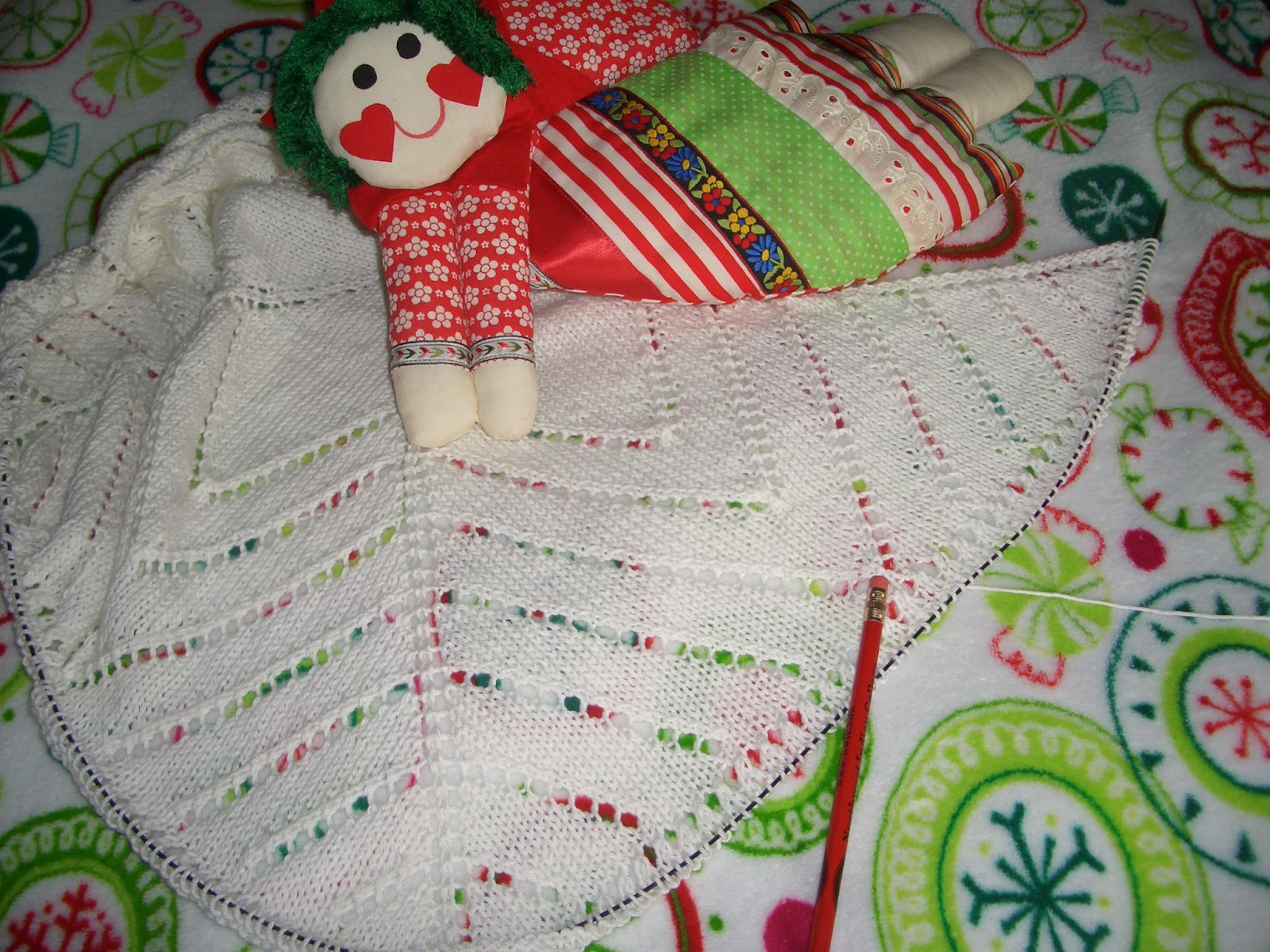
Got there!  Finally finished the third repeat of the first pattern set on the white lace shawl.  Definitely a milepost.  Then the pattern said to switch to a needle size one larger than the one with which I began the shawl.  I started with ad US6 so at the eyelet row -- new pattern set -- I introduced the larger needle.  On the first right side row of the eyelet pattern I began with the new and larger needle.

The red pen is pointing to the last of the chevron points
from the first pattern lace chart.  The row of holes
just above the black needle cord is a row of eyelets.

After the chevrons, the next lace chart begins (and ends) with eyelets.  These are a series of right and wrong side rows that create hole in the fabric, on purpose.  An eyelet series is a good way to learn to add stitches (yarn over) and take away stitches (knit 2 together, K2tog).  The adding and subtracting happen one right after the other and repeat all across the row.

See the holes?  They are shown from top to bottom of the
picture near to the stripe on the angel's robe.  This section
of lace is just beginning.  It will have another pattern of
holes that make flowers with petals and then a
final row of eyelets.

The "change to the next size needle' is not unusual in shawls and other lace knitting.  Bigger needles make bigger stitches so naturally the shawl will grow in size.  This shawl pattern will up-size needles 2 more times.  The last lace chart will be knitted with lots of holes that will appear to be random.  You'll have to wait and see, as will I.

Here's a view of the US6 (now empty) and the US7 (with shawl stitches on the cord between the two tips) and a pencil to give you an idea of relative size.  The last needle I'll be using will be bigger than the pencil.
Size US6 is rosewood; tips and cord are from Knit Picks.
The green plastic tip is from a set from WEBS.
Both work wonderfully.
Under the rosewood tips is the dark pink cord that
joins one tip to the other.  You might want to knit around
and around with these needles or you can just treat each end
as a straight needle and knit back and forth in rows, which
is what I am doing with the shawl.

Circular needles are long cords connecting needle tips.  If the needles are interchangeable, then the tips can be removed and replace by a needle tip of another size, or joined with a longer or shorter cord.  A good set of interchangeable needles represents the very essence of flexibility.

The white shawl is coming along quite nicely.  I'm enjoying it and so far am quite pleased with the outcome.  There are lots of stitches at this point, at least 125 per section.  I'm making three sections so, do the math, that's 375 stitches (and counting) on the long cord between needle tips.

Lots of stitches mean lots of knitting.  One of life's important lessons, I think, is the idea of "less is more."  In lace knitting, especially with shawls that 'grow,' this lesson must be put aside.  And especially in this shawl, when even the number of needles that are used is a total of 4, rather than the usual, maybe, 2.

Less is more might work for shampoo dosage, or pairs of sox, or cars in the garage, or cats in the house.  But this time the rule doesn't apply and the shawl is lovelier and lovelier for having broken all the 'rules.'


Saturday, December 24, 2011

Reality cannot be ignored

Sometime on Thursday I reckoned with reality -- a couple of the Christmas scarfs are not going to be finished for package-opening day.  With that nugget of news, I sat down to make some progress on the white lace shawl.  I wanted to get an idea of just how much knitting is ahead of me.  The best way to get a glimpse of that knitting future is to finish a total repeat of the pattern for a triangle shawl.

During this process the pattern is adding stitches so each row has just a few more stitches than the row below.  Since this shawl is three sections, making half of a hexagon, each right side row adds 6 stitches.  It's very 'comfortable' knitting -- the first pattern is easy to remember and, importantly, easy to correct on a subsequent row when I realize I've missed a yarn-over (add stitch) or knit 2 together (take-away) on a previous row.

Here's where I am now -- finished one repeat of the first pattern, with one more to go.
Santa is standing just to the left of the second point.  There
are 16 rows in the repeat -- 8 right side and 8 wrong side.
At the end of this section of knitting, I'm to the top of
a second point after the original diamond shape.
The knitting bowl is a wonderful companion.  I think wood items are soothing and calming.  They come from trees and I love trees -- trees are strong, sturdy, endure and survive despite storms (in most cases).  And they give us such beautiful and useful things, like houses, cedar trunks to store treasured sweaters, and knitting bowls to keep our unruly ball of yarn both tidy and available. 

This shawl pattern, from Jane Sowerby's Victorian Lace, has one extra instruction that puts it in a category all its own -- the shawl is knitted with three different size needles.  I don't mean that you start with a short needle and then need a longer one.  Though that's true (to hold all the stitches), this shawl begins with a US6 and then progresses thru a US7 and finally a US8.  Well, those are the needles that work with the yarn I'm using; may be different if you select a finer or bulkier yarn.  

Santa's red pencil is pointing to the
next section of the pattern, which I will
begin after I complete one more set of the
rows that make the point.
When it's time to begin the next set of pattern instructions, called a chart in this case because it's not in words but in a diagram, I will remove the US6 points on the long cord connecting them and replace with US7 points.

This is the wonderful thing about interchangeable needles.  Mine are from WEBS and Knit Picks.  No, can't mix between the sets.  Why two manufacturers?  Well, WEBS introduced their set with more tips at a very favorable price.  Knit Picks introduced theirs with three tips, one each in wood, aluminum, acrylic.  Gotta try it all to decide what works best . . . and what I can afford.  

Enuf about that.  

I'm thinking about all the knitters who just know they won't finish that last gift item.  One blog even had a draft note to include, something like "sorry I didn't finish, but I'll deliver the finished scarf/hat/mittens/whatever right after the New Year."  The idea is that you planned this for the person and picked out the yarn and pattern.  And when you worked on it you thought about them.  

So whether it's finished tomorrow or the next day, the gift will always carry all of the knitter's careful work and a piece of the knitter's heart.  Both show the recipient they are a treasured person.

Try to find a minute or two to knit during the next few busy days.  All knitters know that knitting is soothing to a frenzied spirit -- and I think we are meant to have a quiet spirit during this special time.

Merry Christmas


Monday, December 19, 2011

Matched Set

As it says in the pattern intro for these fingerless gloves, they will keep your hands warm while you are "typing or knitting."  These are Andean Silk from Knit Picks, alpaca, silk and merino.  This yarn is just splendiferous -- there's no other word for it.

Finished one.  This is a test -- now that the discovery is complete (new pattern, new stitch combo, etc.) will I be an adult knitter and cast on for the second one.  Will I knit to the completion of a second hand-warmer?

The thumb hole was simple.  Bind off 4 stitches and then
cast them on again in the next row around.
Challenge is to keep with the wavy pattern, an offset rib.
Background is the mohair scarf in Darliss' yarn, pattern
from Whit's Knits at Purl Bee.

Pattern from One Skein Wonders, by WEBS, in NH.  This is a another favorite site for me.  I like the extensive offerings of yarn from practically all makers and all weights and styles.  The sales are really good if you follow them on Facebook.  WEBS

Yes, the second hand warmer IS on the needles, along with a matching scarf.  Here's all three together with the elves (who, sadly, do not knit . . .)
Completed handwarmer at the top (with the nutcracker in
the thumb spot.)  On the gray needles a scarf.  Santa is
resting in the beginning of hand warmer 2.
Love this scarf pattern and have made it once before.  It works well on variegated or solids.  It looks good from either side and the selvedge (edge) stitches keep it flat so it doesn't curl up into a tube.  It's the Universal Scarf from Interweave.  Free pattern.

Use any needle size suggested by the weight of the yarn.
I'm using US10 (6mm) with a worsted weight that's
just a bit fluffy.
The magic of the pattern is that 18 stitches will get you a scarf that's wonderful.  I wanted something just a bit wider so added stitches in groups of 3 (the repeat part of the pattern.)

The collection will keep the recipient warm, even in a cold office while typing or phoning.  And texting will be easy since fingers are available.  The hand warmers work up very quickly since they are on a larger needle (US8/5mm) and the thumb hole is just a big buttonhole.  Bind off 4 stitches and on the next round put them back on.  Nothing elaborate; the wavy stitch pattern speaks volumes.
Details show the wave.  Clever stitch pattern:  P2, K4 for 4 rounds.
Then offset the same stitch repeat by shifting things just one stitch.
Works very nicely in the round.
In between wool knitting I returned to the pima cotton white shawl and added another repeat of the initial pattern over the shoulders.  It's even more satisfying than I remembered.  It's moving along nicely; another couple of pattern repeats and I can begin knitting from the second chart of delicate lace.

Celebrations!  I found my favorite little ruler.  Yes, it was stuck in a book as a place-holder.  I think it was in the Sowerby Victorian Lace.  See, there's a great reason to keep multiple projects on the needles:  when you return to one that's been idle for a bit, you discover you're close to a next fun pattern and you find an accessory that you suspected of having run off with the missing needles.  Some people's knitting stuff . . .


Thursday, December 15, 2011

Wrong combination

Sometimes I look at the large stash of yarn and see a sweater or scarf or vest.  So I pull out a skein or too, do a swatch (maybe), and proceed.  If it's a scarf, I do a lot of guessing -- which needles, how many stitches (after I figure the repeats as in yesterday's post.)

And sometimes it just doesn't work.  My local library had a copy of Knitted Lace from Interweave.  Put it on order and after picking it up from the branch near my home, I discovered -- no surprises here! -- at least 5 things I really like.  One of those is a scarf, in two sizes.

Lovely Andean Silk yarn (worsted weight) and a size US7 needle and I'm knitting.  This pattern follows a different approach:  first you knit the border sideways, starting on one edge you knit a few repeats that make points.  Then you pickup stitches along the edge of the border and knit the length of the scarf.

Words don't work.
The empty needle shows the direction of the knitting
for the points that make the border.
The needle with stitches shows the first bit of
stitches picked up from along the edge

But it's awful -- not the pattern -- but the yarn just isn't right for the pattern.  I considered changing to a larger needle but that would just make things sloppy, even after blocking.  Lace knitting should result in an item that's has nice drape but isn't sloppy like a handful of wet noodles.

Here's the book.  I still love the scarf and may check the stash for some lace weight yarn or even a DK weight, just not this worsted.  Really is a fairly easy pattern.  Would be fun, I think.

Bookmarks and yellow sticks mark the other patterns
I wanna try.  I may have to check Abe Books to see
about buying a used copy.

Still cannot find the small ruler with the needle sizer holes in it.  Tore out all the cushions from couch and favorite chair.  Cleaned out the basket of knitting notions thinking i'd tossed it in there.  Next will have to rummage thru the pattern books I've been reading -- probably used it as a bookmark.

Thought I lost my Brittany US7 needles and that would have really hurt.  They are my needle of choice for the TKGA work.  Plus they are just getting broken in nicely.  Found em in the small brown shopping bag with the three balls of yarn for all TKGA swatches.  Whew!

Still looking for that ruler.  And still looking for the right combination of pattern and needles for the Andean Silk from Knitpicks.  Maybe the fingerless gloves I wanna knit for myself?


Saturday, December 3, 2011

False Starts -- another shawl

Most knitters will tell you they seldom knit the item they originally selected.  Maybe they don't like doing the pattern, maybe they don't like the way the pattern looks in the yarn they selected.  Maybe it just wasn't any fun.

The title of this post calls these "False Starts" -- these experiments are essential to the selection of the final combination of needles, pattern, yarn, and purpose.

Here's the shawl I finally selected.  It's a pattern I can get onto one of those index memory cards in my head.  The pattern works with the yarn -- I checked the directions.  The needles?  Had to step down one size from US 7 to US 6.  The US7 was making a fabric that was too loose.  And this one is fun.  I can see progress; it has at least 3-4 different sections with different patterns (lowering the boring factor considerably.)

Yarn is Comfy Fingering from Knitpicks.
It's cotton with a bit of acrylic to help with keeping the shape
of the final garment.  Also, it can be machine washed
and dried.  This fact encourages the wearer to actually wear the shawl.

This pattern is on page 44 of Victorian Lace Today.  Sowerby resurrected and transformed the Spider Shawls from the mid-Victorian period.  The shawl can be a complete hexagon (6 sections) or half (3 sections.)  I am making the half-hexagon version.

The pattern page from the book shows several things.  First you'll notice only one of 6 sections is charted.  This means you must repeat this pattern for each of the sections you knit; remember, I am doing 3 sections. Other items show the omnipresent yellow sticky note (upper left corner, peeking out), plus a piece of bright yellow highlight tape across a row of the pattern.  It keeps my place and I can remove and reposition as I knit.  It's not opaque, which means I can still see the pattern from rows below the one I'm working on.

Pattern book with necessary tools:  Ticonderoga #2 pencil with
an eraser that works!  A pink row counter (similar to the
counter used by golfers.)  Near the bright red glass bead is
a key ring emergency fixer thing.  It's a two-ended crochet hook
used to pick up stitches that fall off the needles.


I started two other patterns in the same yarn.  One pattern is another offering from Victorian Lace Today and the other pattern I purchased from the Independent Designer Program (IDP) at Knitpicks.  Here's what they look like when I discard and abandon them.  Eventually I will rip them back and re-use the yarn, after I wash it and remove the squiggles formed by the knitting.

Discarded projects do not count as UFO's, which is a good thing.  I have no intentions of returning to either of the rejected shawls.  I won't be tucking them away in a box or bag for a future discovery.  They're toast!
Two beginnings -- one still on the needles, the other a pile of
will-be-tangles-unless-I-rewined-soon yarn.
And they're a lump of knitting.  But each one actually began a pattern. To satisfy the curious readers, I'm including two shots, one of each rejected shawl pattern.


The one I've chosen may appear to be too simple to be elegant, but just wait til I start adding different patterns.  It's great fun and quite satisfying to realize you've made the right choice -- remember I am a process knitter, which means the actual knitting must be enjoyable, even at the expense of something more elaborate as an end product.

This weekend is when I hope to finish the labels and mail the Christmas cards.  May assemble the pre-lit tree and if I do it may stand without decor for a few days.  I have knitting to do.

Have a blessed Advent season.