Why this journey?

I've been retired now for over a year. Husband has been sick but is now doing quite well with new pacemaker. I continue to knit and knit and crochet. Recently I became friends again with my sewing machine so you will see some of those projects, too. Thanks for reading.
Showing posts with label Sowerby. Show all posts

Thursday, November 1, 2012

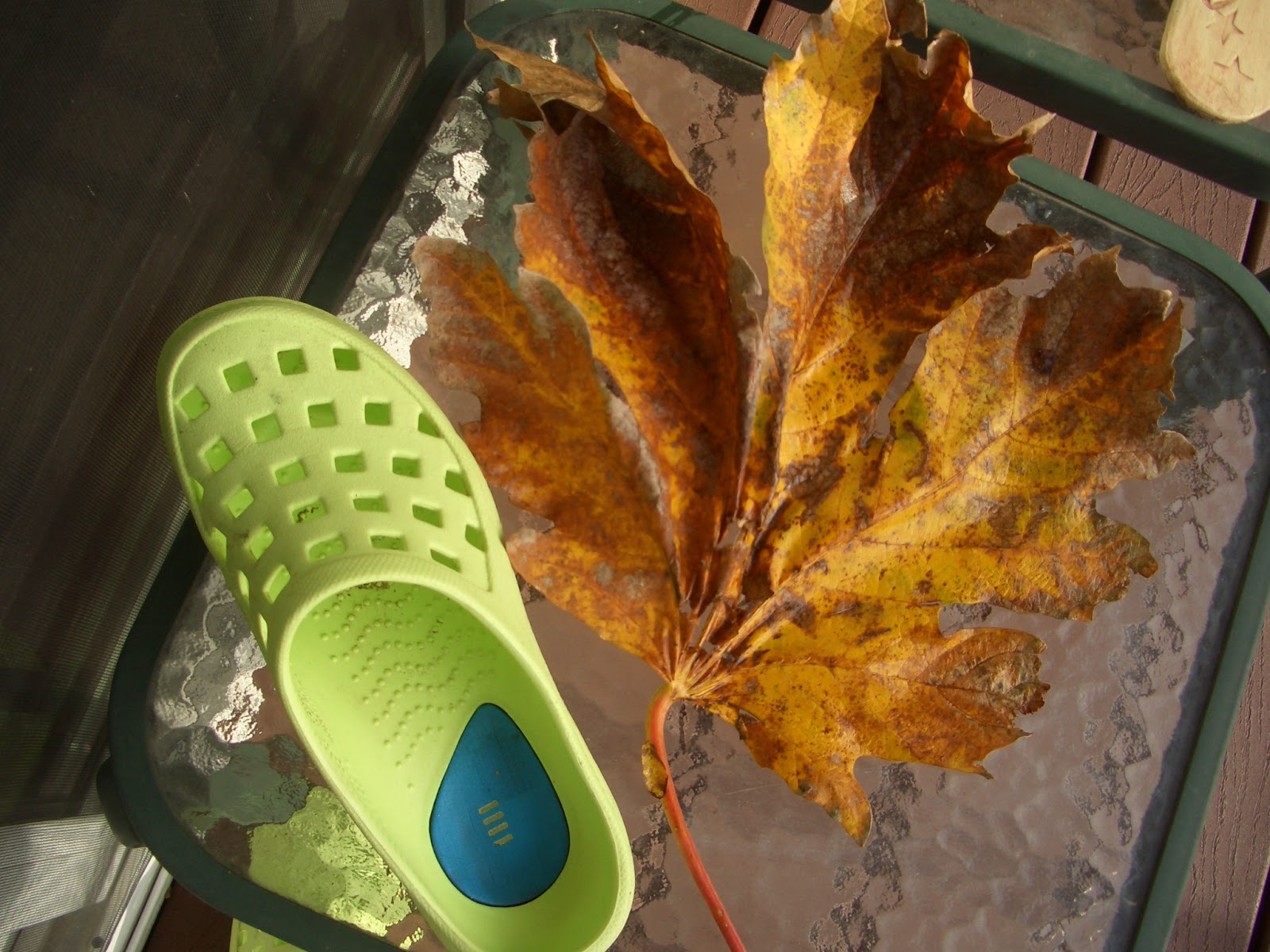
Mostest Biggest

This one is huge.  The neighbor's tree is shedding, as it does every year about this time.  Found this one on the back deck.  It's the most biggest gigantic-est leaf I've ever seen.  Too bad I can't make sox from it.

Meanwhile, we've had lots of rain, though nothing like the tragic weather events on the East Coast.
 I left this pitcher on the deck the last time I felt a need to water thirsty plants.  That was probably early October.  Someone will have to fact check the first date of our NW rainy season (which will end on July 15, 2013.)  The pitcher holds 2 qts.

Meanwhile, closing in on the last bits of knitted-on lace border for the green lace shawl.  Pattern from Victorian Lace Today by Jane Sowerby, one of my favorite lace designers.  
I've turned corner #3 and am making my way across the bottom
of the shawl.  One more corner and a border repeat to
connect to the starting point.
Hope to have this on the blocking board tonight.

When my elderly eyes weary from tiny stitches, I turn to larger needles and yarn.  You've seen this one before, during a progress report.  It's from Weekend Hats, page 89.  All done.  Yarn is Bernat Waverly, very soft.  I used #7 Kollage square point circular (confused!?) and the Magic Loop Method.


The green hat (though it looks gray) is part of Christmas gift knitting, which is the most wonderful knitting I do.  The quiet time with yarn and needles allows me to remember the person for whom the gift is intended.  Now and then I listen to a Rosary and do some praying.  It's all good.

Meanwhile, more rain, and more of the mostest biggest leaves from the neighbor's tree.  It's Fall in the NW.


Thursday, September 20, 2012

26,880

Do you ever wonder just how many stitches you are knitting in a project?  I'm a math nerd so this concept is usually lurking somewhere in my brain as I am doing yet another knit, purl, or yarn-over.

For the Shetland Shawl, from Victorian Lace Today, the answer is
26,880 stitches  for the center portion.

There are 70 stitches across each row, using a pattern with an 8-row repeat.  Instructions call for 48 repeats of this pattern chart.

Math nerds do things like this -- 70 x 48 x 8 = 26,880.  Yikes!  If we knew the answer we might not ever ask the question -- and this would mean no more knitting.  Not a comfortable or pleasant outcome (though the nerd in me will likely continue to do the computations.)

For the Shetland Shawl I am making progress toward a finished center portion.  Knit-on border to follow.  I've started this border, a 12 row repeat with double yarn overs to make nice large holes.  Pictures show the details.

If you look at the upper left you'll see the sticky note
I am using to mark 1) the row I have worked and
2) the number of repeats of the pattern.
Remember 48 is the target -- I am at 29.

Here's the border with its accompanying chart.
The 'rule' is that I must finish a 12 row repeat completely
before I put down the needles.  Border goes up one side,
around the corner, across the top, and so on.

Close-up of the border, unblocked.  Size 4 US dpn, same size
as circular used for the center portion of the shawl.

The light is courtesy of the last of the sunny days we can expect here in the Pacific NW.  Days are opening with heavy fog and chilly temps.  Favorite, and oft-asked question:  Has the sun come out yet?

Hoping your sun is shining.

Saturday, January 14, 2012

The Train

I think I have discovered the mythical tunnel with the light at the end.  Yes, it's a train.

Yet another mistake on the white shawl.  Just about finished with the final pattern and ready to bind off.  I wanted to show myself that I could do just one more row.  And wouldn't you know, about half way into this final row (not counting the purl row to get back to the beginning), I discover a mistake.

Yikes.  The light IS a train and it's heading straight for me.  Several choices at this point -- too boring to describe and too traumatic to re-live -- so I decide to repeat the solution from the earlier mistake.  I decide to rip back by removing the stitches from the needle.

It's encouraging to realize I have actually learned
from my mistakes.  This time I use, not a needle and fine
crochet thread, but Hark, Batman, another needle.
It's a tiny one, a US2, and you can see it peeking out
just to the left of the (seemingly) large teal tip of the
circular needle.

So now all the stitches I want to rip back are sitting securely on the tiny US2 and all I have to do is
  1. Gently pull the yarn out and then
  2. Replace the stitches onto the larger needle.
Here's what it looks like when all the stitches are on the tiny needle and I'm ready to replace them to the larger needle.
Left to right:  Tip of larger needle US9 which I have removed
from the cord.  Next is the cord with a purple cap to prevent
the stitches from escaping.  The skinny gray needle is lying
across the other end of the circular needle.
I am ready to crochet now.  Instead of closing off the knitting by a usual method which makes a firm and finished edge, capturing all stitches one within the next, I will be crocheting some fringe as I seal off the stitches of the shawl.

Left to right again:  Knitting stitches on teal US9.  Then the
size H crochet hook inserted into a stitch, ready to chain
the fringe.  Above and to the right is the beginning
of the fringe.

The next time you hear from me this shawl will be completed and on the floor for blocking.  It's huge and I will need every bit of empty floor space available.  I'm thinking of folding into its respective thirds (remember it's 3 0f 6 sections, or half, of a hexagon) and blocking them one on top of the other.  Unorthodox, for sure.
Lacey fringe to match the delicacy of the shawl.

If I'm not able to make a go of it to the end, you'll find me riding on a train.  A kind soul will have wrapped my shoulders and head with a partially completed white shawl.  And you'll notice -- fashion folks that you are -- that the white shawl matches the long armed jacket I'm wearing.  Another kind soul will have tied the longs arms of my jacket around to the back.  There will be a light at the end but I might not see it thru the mesh of the shawl.


Tuesday, January 3, 2012

Lace is finally 'lacing'

Back on track with the white shawl, after a few hours of grief, more than a bit of anxiety, and even a silent scream or two out of frustration.

After putting all the stitches back onto the (wrong!) needle and doing what I thought was the right thing to center the new design within each section, I relaxed into the pattern.  It's important to 'relax' (read lecture to self) so that the pattern begins to sculpt itself into some cells of the brain.  Then "wrong needle."  Oh well, I'm relaxed, right?!

Began the 'rest row' (as in all purls back across the 300+ stitches) using the correct (and larger needle.)  After a few rows of sorting out the pattern repeats and locations, I think I'm on track.

Finally -- a partial view of the chevrons at the bottom
of the picture.  Moving up you can see a row of
eyelets.  Then the flowers and another row of eyelets.
The last few rows are that pesky pattern that just
wouldn't fall into place.

There's an important 'secret' (read 'tip') to lace knitting, to all knitting for that matter.  You must learn how to read your knitting.  This means you must be able to locate each type of stitch, in its respective row, and determine if a) you've knit the correct technique and b) you've knit this stitch in the correct location relative to previous stitches and rows.

In this picture I've marked with a smaller (US 6) needle the column of stitches that, at last, I was able to read from both the pattern chart and my knitting.
Hoping you can see that the needle is aligned with a
column of stitches to its left.  Above the eyelet (which
is the first hole at the bottom of the picture) you should
be able to see that each stitch is just a simple, plain, and
wonderfully welcome KNIT stitch.

The plain knit stitches line up from row to row and if I can keep this fact in my head and connect my fingers and hands to that fact I will be able to knit the rest of the shawl.  

Within a few rows I'll be up-sizing the needle, yet again, from a US 8 to a US 9.  This is why we have interchangeable needle tips and long cords to connect them -- so we can always have the size and length needle we need.  Extremely flexible concept.

Here's the four needles I will have used for this shawl.
Reading from left to right they are all US sizes,
6, 7, 8, and 9.  (US 8 in use on the shawl at the
time of this picture.)
In anticipation of the joyous and celebratory moment when I will graduate to the final needle size, I have prepared the US 9 needle tip and cord.  Actually I 'borrowed' the US 9 from a UFO (vest in progress) and left behind the knitting accessories which serve as bread crumbs to get me back to where I need to be when I return to the vest.

The blue tip on the blue vest yarn is the US 9 I need.
I've removed the other tip (lying across the top) and attached
a disk that shows me the size US 9.  Then I've applied a cap
so that the stitches of the vest do not escape.
I will repeat for the needle tip now holding vest stitches;
and when I am done the vest stitches will be on the cord, with
no needles.

Oh, but there are just too too many lessons in this project.  But one lesson stands out as supremely valuable.

I once had the following question from a non-knitter:  "Have you ever tried a pattern that you could not do?"

My answer -- and this shawl is an example of the answer and the attitude:  "Only when I assumed I knew how to do it and resisted actually paying attention to the directions."

If you can suspend for a moment all the things you think you already know, then and only then, will your mind and heart be ready to receive a new lesson.

And that's the lesson for today, folks.


Monday, January 2, 2012

Yikes -- major Yikes!

Lace knitting is definitely not for the feint of heart.  I finished the transition row, a pattern of eyelets and small flowers.  It's looking good . . . and I'm feeling smug.
Looking quite nice, I think.  This series of rows will
divide the upper portion of the shawl -- with the chevrons --
from the lower portion which is design to be quite
open and very lacey.

The instructions quite clearly state how many stitches I should have on my needle, but did I count them?  No, no, and what part of "no" do you not understand.  I can't be bothered with counting.

Thus, I launch myself into Chart C, the lacey part of the shawl.  I knit about 10 rows of this 12 row chart (yikes!) and when I look at my knitting it's not at all what the pattern says it should be.  I've already had to adjust for 'not enuf stitches cuz I didn't take time to count.'

Now I'm faced with a major decision.  Here are my options --
a.  I can continue to knit using the stitch pattern I've been using, knowing it is wrong and doesn't look like I want it to look OR
b.  I can 'un-knit' back to the last set of eyelets in the transition pattern and begin anew.

Yikes!  Naturally I choose option b above.  Well, perhaps 'naturally' is too strong a word.  I'm fairly sure there's only a few thousand other crazy obsessed knitters who would insist that the shawl be knitted using the pattern stitches given.

Now what?  It's too many rows to un-knit stitch by stitch so -- Horrors! -- I remove the needle and unravel carefully, very carefully.  
Here's the shawl with loose, sloppy and scary stitches
pretending to be orderly.  Now I have to get them unraveled
and back to the row of eyelets.  Look at the set of ruffly
stitches across the top and then come down to the first row of
holes, the eyelets.

After the unraveling I now have to put each and every stitch back onto a needle.  I use a combination of methods.  I thread a small tapestry needle with a length of crochet thread and use this to anchor some of the stitches.  Then I insert the knitting needle into each stitch anchored by the crochet thread.  

But I'm impatient (surprise?) and so I decide to unravel and put stitches back onto the needle, one stitch at a time.  There are supposed to be over 100 stitches in each of the three sections, so I'm facing a tedious job.

The green knitting needle is carefully re-inserted into each
stitch held by the bit of green crochet thread.
(We're not knitting, have you noticed?)

When all the stitches have been carefully returned to a knitting needle, I decide I just might have to count the stitches.  I re-read the pattern at least 5 times; I count my stitches; I review my work. 

Yikes!  I have only 104 of the required 118 stitches.  Clearly I have not repeated a chart 'one more time.'  But I'm not going back again.  

The new (and final) chart calls for a 6 stitch repeat.  104 / 6 is 17 with 2 stitches remaining.  I distribute them evenly, with one at each end of the section and return to knitting.

I've reached the end of section 1, with the correct number of
leftover stitches (1), after having completed 17 of the
6-stitch repeats.
Yikes!  I'm using the wrong size needle.  But I am not going back, underline not.  I'll pick up the larger needle on the purl side and it won't matter one bit.

Still have not discovered where I went wrong, to have only 104 stitches where I was supposed to have 118.  Relish the mystery!


Saturday, December 24, 2011

Reality cannot be ignored

Sometime on Thursday I reckoned with reality -- a couple of the Christmas scarfs are not going to be finished for package-opening day.  With that nugget of news, I sat down to make some progress on the white lace shawl.  I wanted to get an idea of just how much knitting is ahead of me.  The best way to get a glimpse of that knitting future is to finish a total repeat of the pattern for a triangle shawl.

During this process the pattern is adding stitches so each row has just a few more stitches than the row below.  Since this shawl is three sections, making half of a hexagon, each right side row adds 6 stitches.  It's very 'comfortable' knitting -- the first pattern is easy to remember and, importantly, easy to correct on a subsequent row when I realize I've missed a yarn-over (add stitch) or knit 2 together (take-away) on a previous row.

Here's where I am now -- finished one repeat of the first pattern, with one more to go.
Santa is standing just to the left of the second point.  There
are 16 rows in the repeat -- 8 right side and 8 wrong side.
At the end of this section of knitting, I'm to the top of
a second point after the original diamond shape.
The knitting bowl is a wonderful companion.  I think wood items are soothing and calming.  They come from trees and I love trees -- trees are strong, sturdy, endure and survive despite storms (in most cases).  And they give us such beautiful and useful things, like houses, cedar trunks to store treasured sweaters, and knitting bowls to keep our unruly ball of yarn both tidy and available. 

This shawl pattern, from Jane Sowerby's Victorian Lace, has one extra instruction that puts it in a category all its own -- the shawl is knitted with three different size needles.  I don't mean that you start with a short needle and then need a longer one.  Though that's true (to hold all the stitches), this shawl begins with a US6 and then progresses thru a US7 and finally a US8.  Well, those are the needles that work with the yarn I'm using; may be different if you select a finer or bulkier yarn.  

Santa's red pencil is pointing to the
next section of the pattern, which I will
begin after I complete one more set of the
rows that make the point.
When it's time to begin the next set of pattern instructions, called a chart in this case because it's not in words but in a diagram, I will remove the US6 points on the long cord connecting them and replace with US7 points.

This is the wonderful thing about interchangeable needles.  Mine are from WEBS and Knit Picks.  No, can't mix between the sets.  Why two manufacturers?  Well, WEBS introduced their set with more tips at a very favorable price.  Knit Picks introduced theirs with three tips, one each in wood, aluminum, acrylic.  Gotta try it all to decide what works best . . . and what I can afford.  

Enuf about that.  

I'm thinking about all the knitters who just know they won't finish that last gift item.  One blog even had a draft note to include, something like "sorry I didn't finish, but I'll deliver the finished scarf/hat/mittens/whatever right after the New Year."  The idea is that you planned this for the person and picked out the yarn and pattern.  And when you worked on it you thought about them.  

So whether it's finished tomorrow or the next day, the gift will always carry all of the knitter's careful work and a piece of the knitter's heart.  Both show the recipient they are a treasured person.

Try to find a minute or two to knit during the next few busy days.  All knitters know that knitting is soothing to a frenzied spirit -- and I think we are meant to have a quiet spirit during this special time.

Merry Christmas


Monday, December 12, 2011

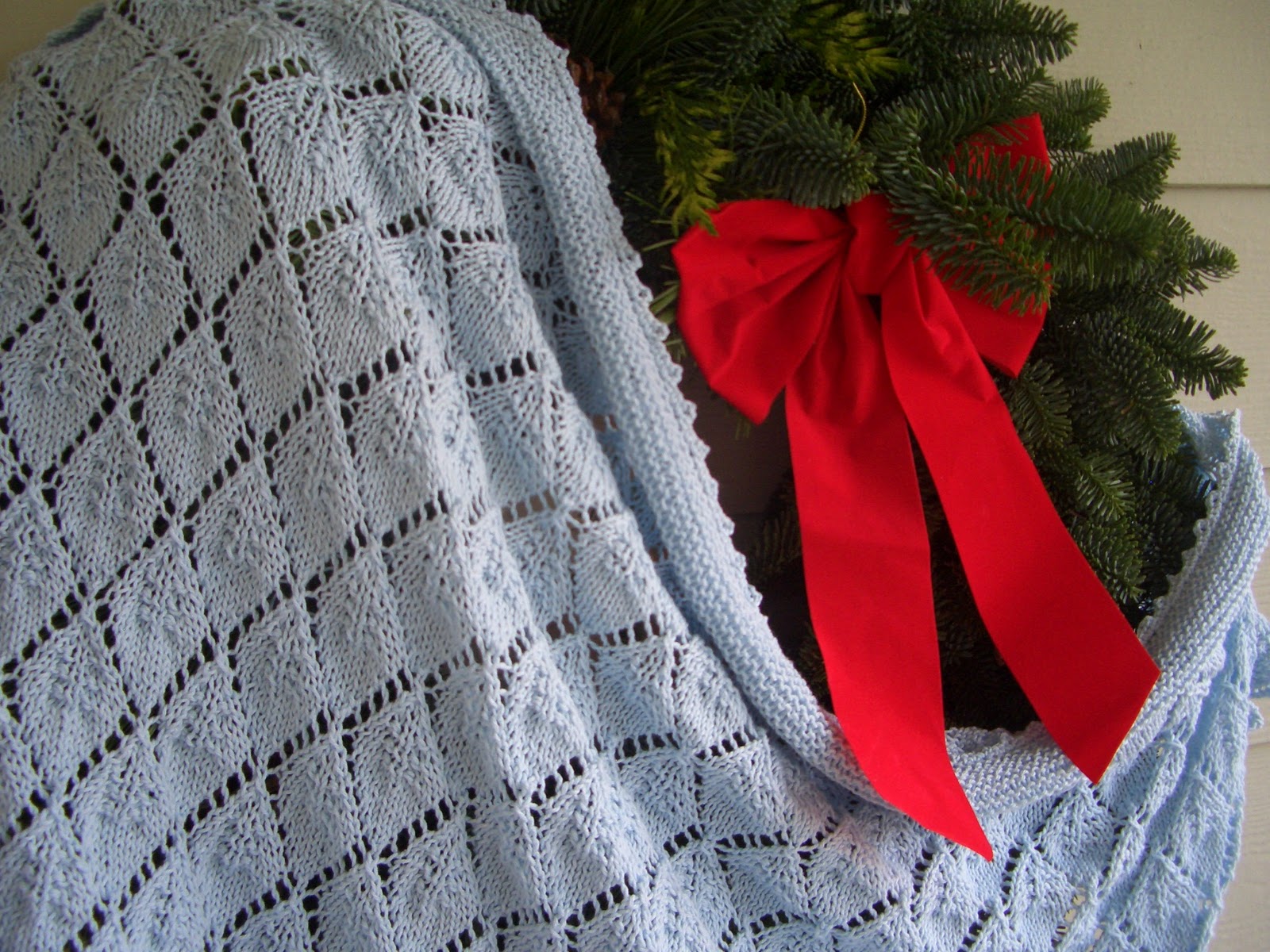
It's a wrap -- blue lace shawl

Last stitches, last weaving-in-ends, last bit of trim.  The blue lace shawl is fini.
Wrapping the wreath and celebrating completion

I wanted to record the last bit of knitting, those last 6 stitches that mean the knitting needles can be put away and I can begin the finishing process.  

Those last bits of knitting are a time for celebrations
  -- the yarn lasted til the end, yeah!
  -- my patience lasted ti the end, yeah!
  -- another finished project, yeah!

Knitting celebrations -- knitters knit because joy is so ever-present.


The shawl measures about 35" from bottom center point to top of the long part that wraps the shoulders.  Here's what it looks like on the blocking board.


And for those who relish the details (and lace knitting has lots of details) here are some interesting geeky facts:
 -- 21 rows of leaves, with each new leaf nesting between two leaves from the previous row.  
 -- If you're doing the math, that's a total of 230 leaves. 
 -- Shawl began with only 3 stitches at the point.  Lots of practice on the add-a-stitch-on-purpose stuff
 -- Last row of knitting, all across the top was 279 stitches.
 -- Those border points?  There are 61 of those, each created from an 8 row pattern, so that's 488 rows to knit.  It felt like 488,888 while I was doing it.  First row has 6 stitches, 8th row has 13.  You do the math, but by any reckoning that's a bunch of stitches.

The last row of leaves, where their nesting shows clearly.
Also the last 14 rows of just plain knitting, knitting
every row for 14 rows.  Makes a nice edge at the top, to match
the sides.  And then finally, a row of picot crochet.

The points on the diagonal edges.  The knitted borders around
the leaves.  A bit of the top crochet picots.

Lace has all the elements of a good movie, though you couldn't sell any of these plots in the 10 minute elevator speech.  

  • Lace knitting requires close attention. Often the pattern requires different actions each and every row.  On the plus side, the patterns sometimes only ask for this furious activity on the right side of the knitting and you can 'take a break' on your way back (called a rest row for good reason!) 
  • Lace knitting has those moments of sheer terror when you recognize on row 83 that you made a mistake and now have to correct it without ripping out thousands of stitches.  (Yes, there are ways to do this, but it's still a heart-stopping moment, albeit brief.)  
  • Lace knitting can also be mind-numbingly boring.  Row after row after row and in most cases each row adds stitches.  So as you slog thru yet another repeat of the pattern you also realize you're facing even more stitches, the same technique, and more stitches.  Over and over and over and over . . . 
  • Lace knitting is so satisfying.  It's always interesting, always complex though in varying degrees, always a challenge.
Lace knitting is gorgeous, always.  Full stop. 

I hope you'll find yourself taking on a bit of lace for the next project, perhaps a scarf.  And if you've been a lace knitter for some time, good on ya! 

This is the kind of knitting you do for a treasured friend or special family member.  Lace knitting keeps you focused on the project for an intense time, and while you are knitting you can recall fun times with the recipient.  You can remember the tears you cried together and the laughs that kept you going.  You'll remember the chat-chat and the share-share.  You'll remember that friends are the gifts God gives us to remind us that we are also treasured -- in His eyes and in the eyes of our friends.  Lace knitting gives us the memory time and the finished garment to tell our friend they are a treasure in our life.

Yarn over, knit 2 together -- stay in touch and keep friendships at the top of your list.


Saturday, December 3, 2011

False Starts -- another shawl

Most knitters will tell you they seldom knit the item they originally selected.  Maybe they don't like doing the pattern, maybe they don't like the way the pattern looks in the yarn they selected.  Maybe it just wasn't any fun.

The title of this post calls these "False Starts" -- these experiments are essential to the selection of the final combination of needles, pattern, yarn, and purpose.

Here's the shawl I finally selected.  It's a pattern I can get onto one of those index memory cards in my head.  The pattern works with the yarn -- I checked the directions.  The needles?  Had to step down one size from US 7 to US 6.  The US7 was making a fabric that was too loose.  And this one is fun.  I can see progress; it has at least 3-4 different sections with different patterns (lowering the boring factor considerably.)

Yarn is Comfy Fingering from Knitpicks.
It's cotton with a bit of acrylic to help with keeping the shape
of the final garment.  Also, it can be machine washed
and dried.  This fact encourages the wearer to actually wear the shawl.

This pattern is on page 44 of Victorian Lace Today.  Sowerby resurrected and transformed the Spider Shawls from the mid-Victorian period.  The shawl can be a complete hexagon (6 sections) or half (3 sections.)  I am making the half-hexagon version.

The pattern page from the book shows several things.  First you'll notice only one of 6 sections is charted.  This means you must repeat this pattern for each of the sections you knit; remember, I am doing 3 sections. Other items show the omnipresent yellow sticky note (upper left corner, peeking out), plus a piece of bright yellow highlight tape across a row of the pattern.  It keeps my place and I can remove and reposition as I knit.  It's not opaque, which means I can still see the pattern from rows below the one I'm working on.

Pattern book with necessary tools:  Ticonderoga #2 pencil with
an eraser that works!  A pink row counter (similar to the
counter used by golfers.)  Near the bright red glass bead is
a key ring emergency fixer thing.  It's a two-ended crochet hook
used to pick up stitches that fall off the needles.


I started two other patterns in the same yarn.  One pattern is another offering from Victorian Lace Today and the other pattern I purchased from the Independent Designer Program (IDP) at Knitpicks.  Here's what they look like when I discard and abandon them.  Eventually I will rip them back and re-use the yarn, after I wash it and remove the squiggles formed by the knitting.

Discarded projects do not count as UFO's, which is a good thing.  I have no intentions of returning to either of the rejected shawls.  I won't be tucking them away in a box or bag for a future discovery.  They're toast!
Two beginnings -- one still on the needles, the other a pile of
will-be-tangles-unless-I-rewined-soon yarn.
And they're a lump of knitting.  But each one actually began a pattern. To satisfy the curious readers, I'm including two shots, one of each rejected shawl pattern.


The one I've chosen may appear to be too simple to be elegant, but just wait til I start adding different patterns.  It's great fun and quite satisfying to realize you've made the right choice -- remember I am a process knitter, which means the actual knitting must be enjoyable, even at the expense of something more elaborate as an end product.

This weekend is when I hope to finish the labels and mail the Christmas cards.  May assemble the pre-lit tree and if I do it may stand without decor for a few days.  I have knitting to do.

Have a blessed Advent season.

Thursday, December 1, 2011

Growing and Growing -- Lace Shawl

Passed a major milestone knitting the blue lace shawl.  I finished the big triangle which forms the wrap-it-around part of the shawl.  Now I'm knitting on the border.  Tedious -- 6 stitches, increasing to 13, back to 6 and all in 8 rows.  Then repeat and repeat and repeat.

Lace shawl with the beginning of the border

The little triangles on the border go from upper right down to the point and back up to the left.  Then when that's done, a crochet border across the top.  So get ready for another post when I get to that point.  Right now it feels like I'm slogging thru quicksand.  The more I knit, the farther I have to go.  Every time I finish one set of 8 rows, there's another set to do.  

Life lesson perhaps:  Knitting borders on shawls is like washing dirty dishes.  You wash one and another dirty one appears.  Not sure what the lesson is, except that -- like the dirty dishes -- twill all come clean in the end and I will have a gorgeous lacy shawl as a result of my labors.

Here's a shot of the border with its pattern.  Hoping you can see the codes and symbols.  In this case, every row is different, so there's no taking a break on this one.  Attention, pay attention.  Pay close attention.

I'm using what's called a double-pointed needle.  It's about 5 inches long,
with a point on each end.  (Can't find the ruler, so this will give you
a sense of size.  Knitting notions disappear often into the
cushions of the sofa or another project bag.)

The border is open and provides an interesting finish. The pattern is from Victorian Lace Today, by Jane Sowerby.  She re-incarnates the patterns from Victorian knitters and each shawl and scarf is a gorgeous testament to the ladies who put knitting into print.  Book also shows early patterns -- and if you think the above chart is unfathomable . . . 

One more picture to give you a better idea of how the border looks next to the body of the shawl.
Now, isn't that wonderful?

Measurements?  Don't know.  On purpose.  Not interested in learning I have 17 miles of border to knit and oh, by the way, I'm only a half mile into the journey.  I'll get there when I get there and along the way these 8 rows and I will become BFF and I will continue to marvel at the unfolding of the garment.

Back to the border.  Make it a great day.  The cookies were a big hit at dinner last night.  There's a few left and I'll try to use their chocolate-ness as an excuse not to eat them.  Sticky fingers leave horrible stains on silk yarn and I'll be knitting most of the day.


Wednesday, November 30, 2011

The Mail Arrived!

The title sounds like something a retired person would cheer about, as an event to break up an otherwise tiresome day.  Not so for this RP (retired person.)

The mail brings a regular supply of used books I order from Abe Books.  Love that site.  Lots of used book sellers in one place; thorough reviews of both the seller and the book; customer service is grand.  So I buy from them a lot -- especially knitting books.

I use my knitting books a lot.  I enjoy searching out the best way to execute a particular technique.  Patterns are always fun to browse and dream about.  Finishing a garment has its special challenges so the books help in that area.

Here's the newest volume I've added to my library.  It's from 1993, author is a Spanish woman named Montse Stanley.  Great details on all techniques from beginning to finishing.  I especially like the section titled "For Beginners in a Hurry."  That way the eager learner can get started right away, minimizing what can be the intimidating aspects of knitting.
Montse Stanley -- a really great handbook.
If you're just getting started, go to Abe Books and buy a used copy.
The one in the picture is 'gently used.'
Nancie Wiseman is a knitting expert I turn to for details on finishing, lace, cables, entrelac, etc.  Here are two of her books I use a lot.


Big Book of Knitting is another great one, as are two magazine volumes I've had since the 70's.  The mags are from Mon Tricot  (which I think means My Knitting, in French, and the French-speaking readers can correct me.)  Great books of stitches and specialities like pockets and v-necks and buttonholes.  You probably never imagined that two needles and yarn would require so many books!
Big Book of Knitting (Buss) with a very famous reprint
from Elizabeth Zimmerman, "Knitting without Tears."
And there's Nancie's book again, the best book ever
for finishing techniques.
Here's one of the two volumes I have from the old
Mon Tricot.  Notice it includes crochet also.
Oven alert!!!  That's what I get for believing I can multi-task.  Almost burned a batch of cookies.  They're chocolate with mint chips and ooooh so good.  Can you smell them?  Chocolate dough comes, not from that awful dry cocoa, but from melting butter (1/2 cup) with semi-sweet choc chips.  Too wonderful for words.

More on the books -- 

A must-have if you're going to try Lace Knitting.
In this volume the charming and talented Jane Sowerby
explores and explains the early knitters who put patterns into print
during Victorian days.  Jane collects those beautiful ideas and stitch patterns
into a collection of perfectly wonderful lace shawls and scarves.
BTW:  The photography in this book is worth the cost of the book.
Alexis Xenakis, of XRX is the picture-taker.

Start your own library today.  Knitpicks usually has 40% off on some collection of titles.  Interweave on line always has a sale on patterns or books.  And never forget to browse your LYS (local yarn shop) to see what new thing might not have made it to the used book category yet. 

If the Santa in your life asked you to give some ideas -- what's better than a good knitting book.