Why this journey?

I've been retired now for over a year. Husband has been sick but is now doing quite well with new pacemaker. I continue to knit and knit and crochet. Recently I became friends again with my sewing machine so you will see some of those projects, too. Thanks for reading.

Tuesday, February 14, 2012

Joyce Fassbender

Joyce is an independent designer whose talents are featured at Knit Picks.  She's known for lovely, elegant, yet simple-to-knit- shawls.

I've used her Deja Vu Scarf at least 4 times.  The pattern gives instructions to increase (or decrease) the size.  This scarf/shawl begins at the middle of the neck and expands as stitches are added.  Joyce's original design created two triangles, with a lacey pattern finishing the edges that wrap around your arms.

The center back (with a triangle on each side) can be
seen in the right of the photo.

If two is good, then three must be better.  I took out my pencil, calculator, a scrap of an envelope and proceeded to expand Joyce's 2-triangle design into a three triangle shawl.  I'm thinking that the final will wrap around the shoulders more securely and sit quietly without a lot of tugging or pulling or fretting.  You know shawls -- they look great but can sometimes be a fashion bother.

Here's the 2-triangle vs the 3-triangle.  The pin is where you wanna focus your attention.

Almost finished with the gold shawl (color is called Chamois.)  I'm knitting thru stash and will not have enough of the Chamois.  I've decided to finish the last of the border lace with the green, Asparagus.

Since I increased by another set of 18 rows in the st st
area, the final lace border has more repeats.  Lots of markers
to keep this one on track.  I Heart Markers.

The yarn is Red Heart Eco-Ways, 70% acrylic blended with 30% recycled polyester (old Nehru jackets and tacky plaid skirts, perhaps?)  This is one of the very nicest acrylics I have ever used.  It's soft and well-plied, which means the stitches are well-defined after knitting.  Check it out.

Now that I know I like the yarn, I'll be looking for the next stash-buster item to use the other skeins I have, in Cinnabar and Bark and Yam.  The color names are as wonderful as the colors.

Around the globe -- the Fassbender shawl is headed for Ocean Park, carrying prayers


Friday, February 10, 2012

Another one leaves the nest

Got to thinking about all the knitting projects that I've sent to different people over the years.

This one's ready to wing its way to the recipient.  I love knitting and I love knitting for others, thinking about them as I knit, thinking about them as I choose the project and pattern that will be best for them.

Paton's Chunky Shetland, size US13 needles.
Pattern from Prayer Shawl book


  • The cowl is in Richmond.
  • Scarves are in Wenatchee, Perth (Western Australia), Seattle, Connecticut, NYC, Anchorage.
  • Shawls are in Florida, Arizona, one to Amsterdam but now in Chicago, Lakewood.
  • Afghans are in Baltimore, Cincinnati, Alaska.
  • Sweaters are in Lakewood.
  • Baby preemie hats are in Africa.
  • Who knows where the Special Olympic scarves landed, around the neck of a deserving athlete.

Several projects on the needles will find their way to another place on the planet, to other people that share my world.

Most of the knitters I know knit for others, either a friend or a deserving group (homeless, preemies, chemo patients, and more.)  Keep sending your talent into the world; the world is better for it.  Leaving your nest allows the work of your hands to warm the next nest.

Thursday, February 9, 2012

The Vest of the Story . . .

. . . with apologies to Paul Harvey, a great newscaster.

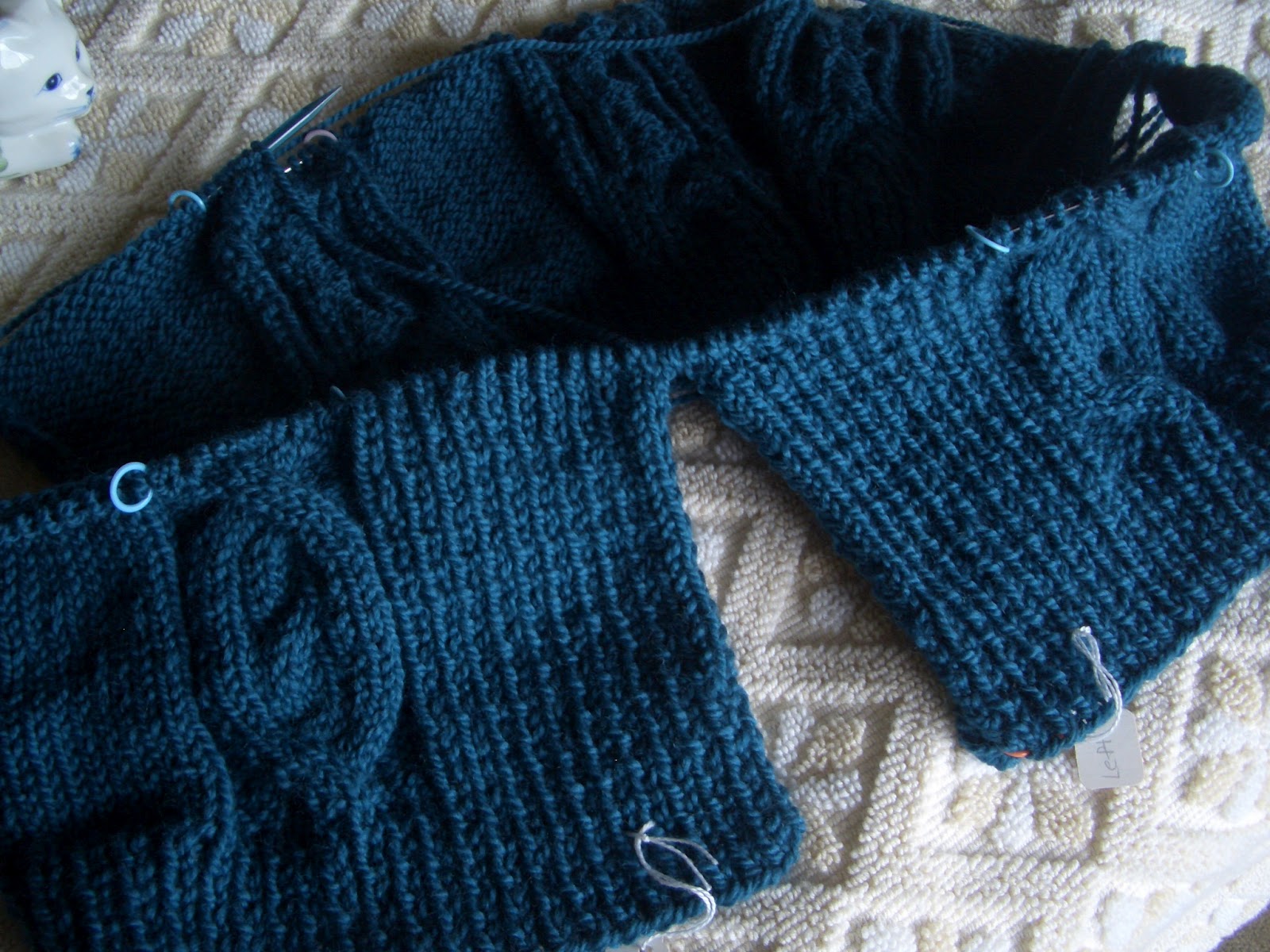
Finally put the yarn and needles together for the dark teal vest.  LB Collection Organic Wool from Lion Brand.  It's a bit chunkier than worsted so I'm using US9 needles; the gauge worked out right per the pattern, so it's all good.

Big complex cables on the front and back.  Hoping you
can see that the big cable is encasing a smaller cable.

This is one of those patterns that demands even knitting tension and the cables are unforgiving, mistake-wise.  So I put all three pieces of the vest -- two fronts, left and right, and the back -- all on one long circular needle.  This means that each piece will be knit under the same conditions -- my stress level, the weather, the amount of moisture in the air -- and by knitting all pieces at once I have greatly increased the probability that the end product will appear (and BE) uniform.

You're looking at the two fronts as they will meet
when the garment is worn.  In the back, in the shadows is
the back of the vest (wrong side as you are viewing it.)

The cables are wonderful.  They are chunky and have several crossing areas within other crossing areas.  The chart is in the pattern, also from Lion Brand, Cabled Teal Vest, though of course there are other colors.  Finished garment will also have a hood.  I may try to find a pewter clasp (called a frog) to join the fronts when it's worn, but the pattern is designed to be worn open.

Here's a close-up of the cable.  Love it.
This shows two of the three chunky cables that will
snake there way up the back of the vest.

The Vest of my story is that this project is moving along nicely.  The additional not-to-be-ignored truth is that once again I have too many projects on my needles.

I am -- after all -- a knitter.  I am Vest-ed in keeping my needles busy.


Tuesday, February 7, 2012

Thuh Key

Knitters know this as an unforgivable truth:  The Key to knitting to size is gauge.  The number of stitches in each inch of each row and the number of rows in each inch of fabric creation dictate the final size (and fit) of the garment.

Lots of other variables, of course.  This IS life, after all.   You might knit with different tension one day versus another -- due to temperature or stress.  Your yarn might behave differently due to the weather, as in moisture content.

But it is a knitting truth that you must measure the gauge before you start the garment.  Here's the way it worked for me.

Two swatches, a ruler, a calculator and a place to
record the results.

Two swatches, using two different size needles.  The US3 yielded only 6 stitches to the inch; the US2 produced a finer fabric and almost 8 st to the inch.

Tiny needles either way.


Size US 3 above the pencil.

Size US2 below the pencil.

What difference does it make?


Two needles, same yarn, different 'fabric,' which means different feel, different texture, different look, and different drape.

The difference that shows most dramatically in pictures
is the difference in the ribbing.  On the left, two repeats
yields one inch+ of ribbing, with big holes and not
enuf definition.
Now look between the 1 and the 2 on the ruler.  Smaller
needles yield 'tighter' stitches and a 2 ribbing repeat of perhaps
3/4 of an inch.
And it makes a big major huge can-be-regrettable difference in the final size of the garment.  I won't bore you with the math.  And just in case you want to use the I am not good with math excuse, every book out there (well practically every one) tells you how to make the adjustments.

The gauge is the key and lest you forget, your finished garment will remind  you the first time you wear it.  It will either have sleeves that are too short or it will begin at your knees when you planned a nice plain cardi to sit at your waist.

Open the door --

Monday, February 6, 2012

No right side

One side or the other, it doesn't matter.  Think reversible.

I went back and reviewed Whit's requirements for a scarf, from the Purl Bee Rick Rack Scarf.    In the designer's words we read:  
After all, the criteria for a scarf pattern are rather stringent: something that lies flat, that looks good on both sides and that has a soft and beautiful drape.
Working on the cream shawl, an easy and satisfying pattern, gave me a chance to really think about the design.  Hint:  It's a 3 row pattern.  Conclusion:  It's reversible, as in no right side (and no wrong side, for that matter.)

While this revelation may not be astonishing -- or even interesting -- to some readers, this very idea launched me onto a whole new knitting space.  I've decided to do a couple of things to see if the exploration of this new space is both fun and rewarding.

Here's the white shawl -- no right side.
Folded the long shawl over onto itself so you could see the
'other' side.

Now, this pattern is both easy and satisfying (and didn't I already say that?)  The pattern itself is 28 stitches, and repeats itself just two times across the shawl.  It's got no right side, so how would that work in a scarf?

I took the leftovers from the Bernat Mosaic Cowl and cast on 28 stitches on a US 10 1/2 needle.  Here's what I've got so far.
On top of the cream shawl, the scarf pattern shows up clearly
and I already know it has no right side.
The Purl Bee Rick Rack scarf has no right side.  I've used a pattern from 101 One Skein Wonders that also has no right side.  And the Universal Scarf from Interweave has no right side.

So I am on a search for patterns that create no right side, maybe have 3 or 5 rows, or maybe a 4 row pattern  that will work if I eliminate the last row.  This is called a knitting adventure.  Please note that I do not need special shoes or boots, no special climbing gear, nothing to protect me from the elements.  And please also note that the sun is shining today so I will perhaps sit IN the elements on my back deck and search for other knitting discoveries that have no right side.

Friday, February 3, 2012

Inspiration

A knitting book from 1942.  Classic designs.  Perfect inspiration for the next project.

Using the wonderful vintage knitting books (gift from a friend) and an un-used gift card I made my way to my LYS, Yellow House Yarns in Puyallup.  Walked out with splendiferous yarn for two grand projects, each inspired by designs from the vintage books.

First book is from Minerva and contains classic cardigans and vests and a cable pullover.  Plus some very helpful advice on how knitting can help the war effort (WWII, that is.)  I know lots of knitters who are helping with hats and stump covers and other items during 'our wars.'  Giving . . .

Pockets and everything.  Classic and Elegant.
The yarn is Cascade sock yarn, 75% wool, 25% nylon.  I'll be using a small US3, targeting the gauge suggested by the pattern shown above.  I've knitted a nice big swatch so measuring will be both easier and more accurate.  In the swatch I've also tried two different ribbing patterns.
I've decided on the ribbing right at the bottom.  It's
from an old pattern book Mon Tricot Stitch Dictionary.  I've had
the book since the 70's so even the rib is 'vintage.'

Here's a better picture of the swatch so you can see how the yarn pools into these yummy shades of gold and cream.  Twill make a loverly cardi I think.
Swatch on the blocking board.  Just above the eyelet
ribbing is the other rib pattern I tried.  You can see
why I kept searching for something better.

I'm completely inspired.  The old pattern is so simple.  It's not written for any sizes that even come close to the ladies of today.  Ladies then were all so small.  The size 16 has a 35" bust -- different times, different sizes.

Meanwhile I've got a couple of projects that need attention.  That other glub is still minus some fingers.  The prayer shawl is about 1/3 completed.  One other item is on the blocking board and will be mailed tomorrow.

Oh, I sent Thuh Notebook on Tuesday.  Now we wait -- 6 to 8 weeks, while the critique takes place.  I'm not one to sit and twiddle my thumbs, though.  I've got knitting to do.


Wednesday, February 1, 2012

It's a done deal

Lookin' good, huh!  It's bright without being gaudy or loud.  The Cascade 200 Paints pulls it all together.
It's no longer a UFO, but a wearable art textile, a lovely hand-knit sweater which I will wear with joy.
Adding the variegated yarn helped with the 'interest' factor,
I think.  Touches of it on the sleeve to pull it
all together.

I made some changes in the pattern.  
Moved the buttons from shoulder to center right.

Added the attached (knitted on) I-cord around the neck so the neckline would appear more 'finished' and be connected to the rest of the sweater.  Check Nancy Wiseman's The Knitter's Book of Finishing Techniques.  If you are limited in what you can spend to add to a knitting library, make sure you include this one.  Essential techniques for beginning and ending knitted garments.  Good pictures, too.
I-cord requires DPN's and a fair bit of patience, but
it's worth it for finishing either a neckline or a front
edge, especially if there are no buttons.
I added the Cascade 220 Paints to coordinate with the Cascade 200 Superwash blue.  Paints in the lower ribbing, the yoke, and an accent on the lower sleeve.
In this case I prefer more ribbing to less -- makes for a
fit that is more precise.  This sweater didn't even
approach the 'classical sloppy' look but rather
seemed to be designed for a fitted look.  (IMHO, of course.)

So I will spend this afternoon and evening weaving in ends.  Since the yarn is washable, I will likely throw it all in the laundry (in a large mesh lingerie bag) and then in a low-temp dryer.  How convenient is that.

There are no, underline no, seams.  How wonderful is that.  Knit from the yoke down, this sweater is all done when it's done.  Sleeves are done on DPN's from the yoke with picked up stitches under the arm so there isn't even a tiny seam there!  

But still, all those pesky tails.  

On the special gift front:  I have several folks who are lovers of the garage sale experience.  These friends have been on the lookout for knitting books.  The books arrive by mail or hand delivery (from friends close, geographically.)  

I have books from the 60's and 70's (yes, we did wear some of those awful clothes and colors!)  And today I received two books from 1942.  Every design is classic -- cardigans, car coats, skirts, jackets, even an argyle cardigan.

Reckon I'll make a trip to my LYS -- there are at least three designs that deserve to be knitted in the 21st century.