Why this journey?

I've been retired now for over a year. Husband has been sick but is now doing quite well with new pacemaker. I continue to knit and knit and crochet. Recently I became friends again with my sewing machine so you will see some of those projects, too. Thanks for reading.

Tuesday, December 13, 2011

NAS! Not Another Scarf!

Officially speaking I now have at least 4 scarves on needles or hooks -- with me on 'pins and needles' hoping to finish each one in time for Christmas gift-giving.  Every year a vow not to do this -- it's not that I don't love knitting for others; it's that I always get the "just right for this person" idea with too few days left to knit.

I'm not the only knitter that does this.  If you are a knitter or read about other knitters, you will have heard or read the story of "up til 3 am to finish that one."

Inventory --

This one is crochet.  The pencil is added to give you a sense of the size of the hook.  It's a B US, for those who also crochet.  The yarn is lace weight, meaning tiny and fine.  It's also variegated.
Crochet.  Lace weight yarn.  Hook size B.  Pattern from
Interweave
This one is heavier yarn, called worsted weight.  The needles are from my special set of Brittany wood needles; they are warm to the hands and smooth so the wool slides.
Needles about the size of the pencil, size 8US.
Wool yarn from Rowan.  Pattern from a new book
Textured Stitches.
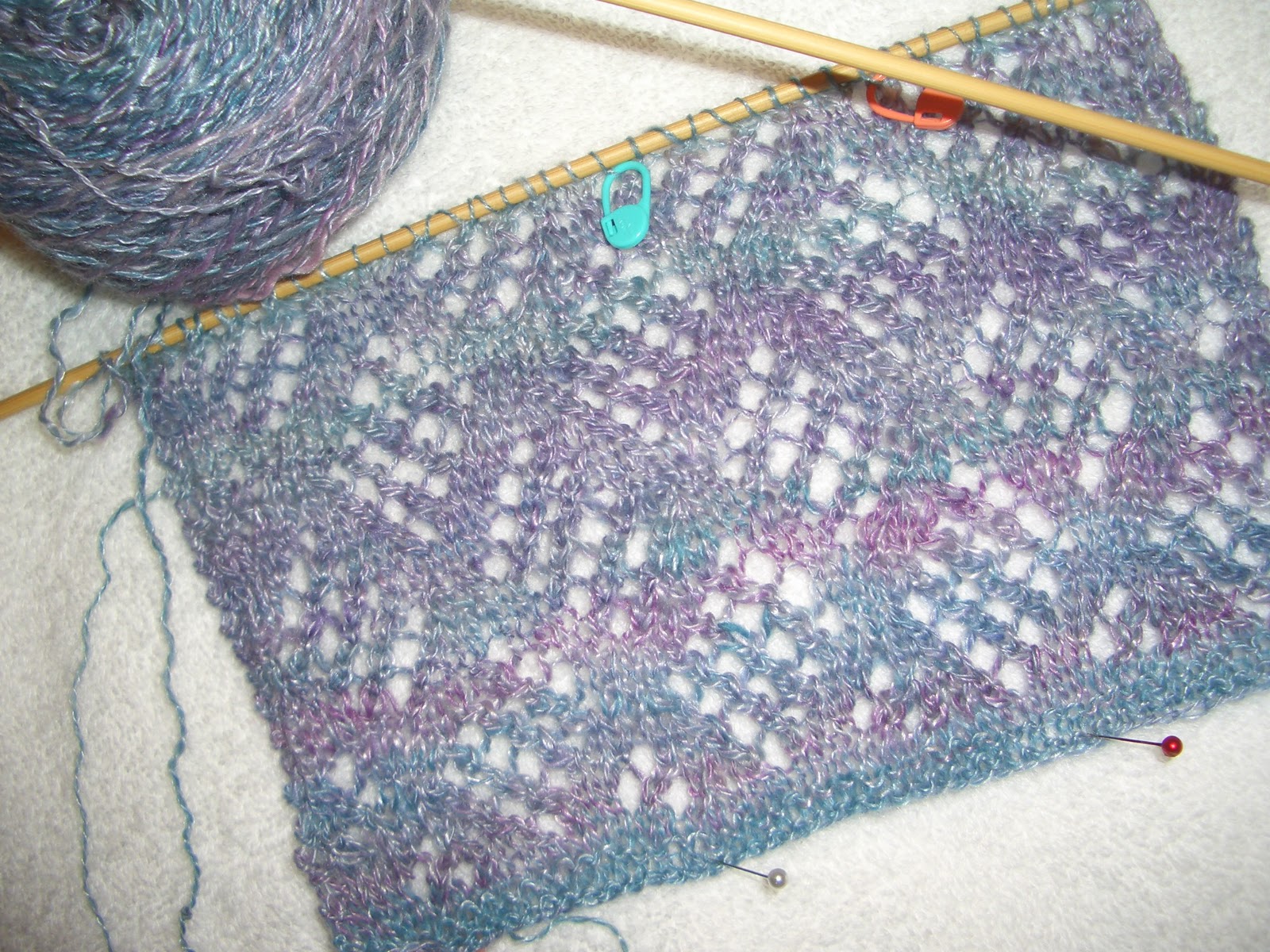
Next is a progress shot of the mohair lace scarf.  When I first showed this one it was wider.  I knitted until it was about 5 inches long and decided two things:  1) not enough yarn; and 2) too wide for the type of scarf (as in, "it's not a shawl.")
This time the needles are actually a bit larger than
the pencil, in diameter.  10 1/2 US.
Pattern is from One Skein Wonders.

And finally (as a reminder to me that I really must go knit), another showing of the Checkerboard Lace scarf using the Darliss Yarn, with pattern from Purl Bee.  No pencil in this picture.  Needles are smaller than the pencil.
Just gorgeous, that pattern at  Purl Bee

Back to projects.  Each one offers something different and I like knowing that my mood and my projects can be coordinated.
  • Checkerboard Lace -- when I'm feeling sassy and ready to take on the world; no pattern is too tough
  • Burgundy Cables -- when I need a reminder that I know how to do cables and a project that's working up quickly
  • Mohair Lace -- when I just need to knit.  There's only one pattern row and then three rows of just knit knit knit
  • Crochet scarf -- when I want to rest the knitting brain and work on a delicate difference
How wonderful that I can review the inventory, pick up a project and put it down for another.  Oh, that life allowed us to do more matching mood with to-do's.  Not always easy to be enthused about some tasks, but even mundane 'chores' like unloading the dishwasher can be a reminder that we are blessed with abundance.  Lots of women have to haul water just to quench their children's thirst.

If you're looking for a place / way to help, check out World Vision.


Monday, December 12, 2011

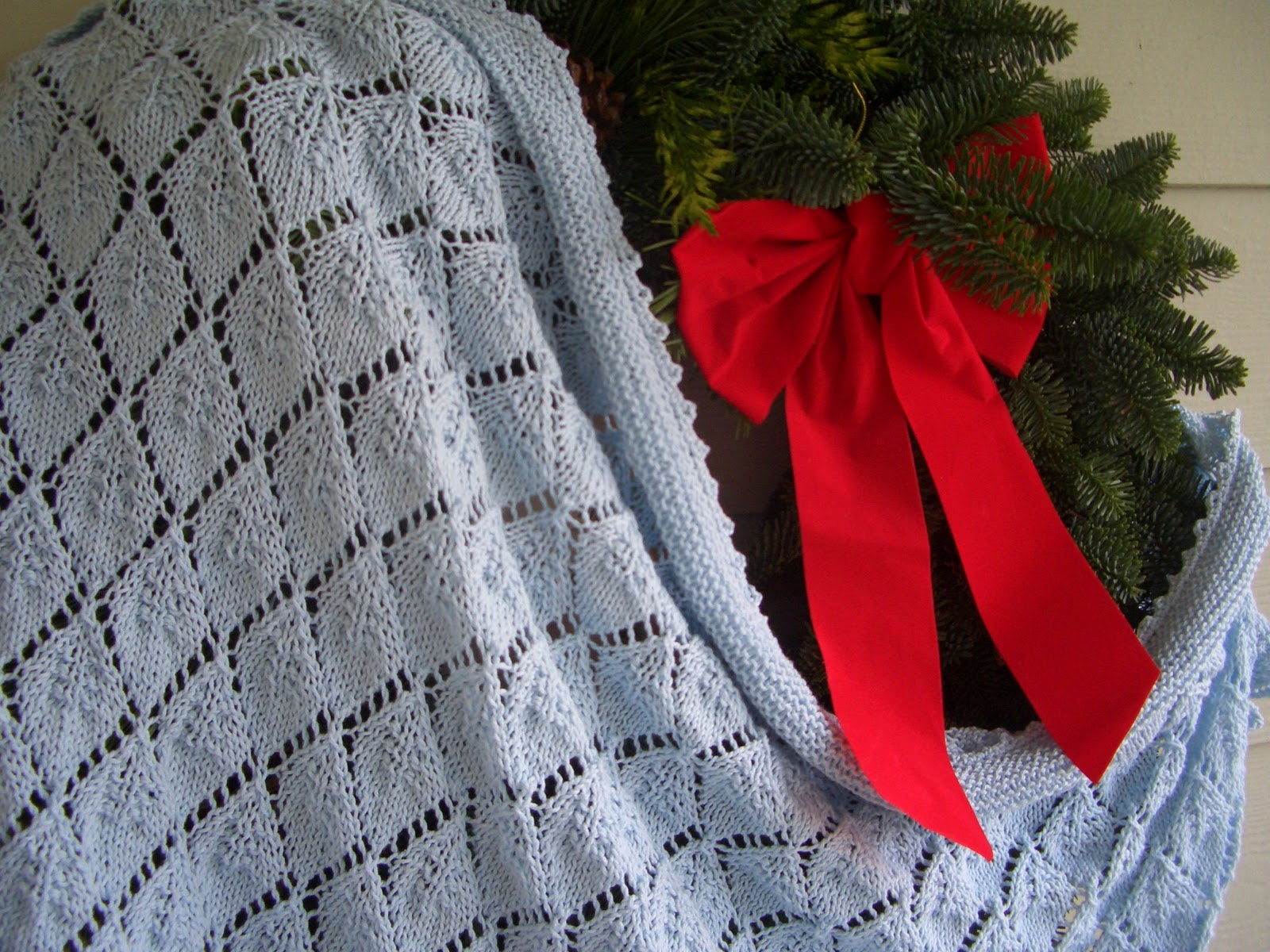
It's a wrap -- blue lace shawl

Last stitches, last weaving-in-ends, last bit of trim.  The blue lace shawl is fini.
Wrapping the wreath and celebrating completion

I wanted to record the last bit of knitting, those last 6 stitches that mean the knitting needles can be put away and I can begin the finishing process.  

Those last bits of knitting are a time for celebrations
  -- the yarn lasted til the end, yeah!
  -- my patience lasted ti the end, yeah!
  -- another finished project, yeah!

Knitting celebrations -- knitters knit because joy is so ever-present.


The shawl measures about 35" from bottom center point to top of the long part that wraps the shoulders.  Here's what it looks like on the blocking board.


And for those who relish the details (and lace knitting has lots of details) here are some interesting geeky facts:
 -- 21 rows of leaves, with each new leaf nesting between two leaves from the previous row.  
 -- If you're doing the math, that's a total of 230 leaves. 
 -- Shawl began with only 3 stitches at the point.  Lots of practice on the add-a-stitch-on-purpose stuff
 -- Last row of knitting, all across the top was 279 stitches.
 -- Those border points?  There are 61 of those, each created from an 8 row pattern, so that's 488 rows to knit.  It felt like 488,888 while I was doing it.  First row has 6 stitches, 8th row has 13.  You do the math, but by any reckoning that's a bunch of stitches.

The last row of leaves, where their nesting shows clearly.
Also the last 14 rows of just plain knitting, knitting
every row for 14 rows.  Makes a nice edge at the top, to match
the sides.  And then finally, a row of picot crochet.

The points on the diagonal edges.  The knitted borders around
the leaves.  A bit of the top crochet picots.

Lace has all the elements of a good movie, though you couldn't sell any of these plots in the 10 minute elevator speech.  

  • Lace knitting requires close attention. Often the pattern requires different actions each and every row.  On the plus side, the patterns sometimes only ask for this furious activity on the right side of the knitting and you can 'take a break' on your way back (called a rest row for good reason!) 
  • Lace knitting has those moments of sheer terror when you recognize on row 83 that you made a mistake and now have to correct it without ripping out thousands of stitches.  (Yes, there are ways to do this, but it's still a heart-stopping moment, albeit brief.)  
  • Lace knitting can also be mind-numbingly boring.  Row after row after row and in most cases each row adds stitches.  So as you slog thru yet another repeat of the pattern you also realize you're facing even more stitches, the same technique, and more stitches.  Over and over and over and over . . . 
  • Lace knitting is so satisfying.  It's always interesting, always complex though in varying degrees, always a challenge.
Lace knitting is gorgeous, always.  Full stop. 

I hope you'll find yourself taking on a bit of lace for the next project, perhaps a scarf.  And if you've been a lace knitter for some time, good on ya! 

This is the kind of knitting you do for a treasured friend or special family member.  Lace knitting keeps you focused on the project for an intense time, and while you are knitting you can recall fun times with the recipient.  You can remember the tears you cried together and the laughs that kept you going.  You'll remember the chat-chat and the share-share.  You'll remember that friends are the gifts God gives us to remind us that we are also treasured -- in His eyes and in the eyes of our friends.  Lace knitting gives us the memory time and the finished garment to tell our friend they are a treasure in our life.

Yarn over, knit 2 together -- stay in touch and keep friendships at the top of your list.


Saturday, December 10, 2011

Hat City -- ta dah!

Hat!  Hat!  Hat!
I like the striping and I like the colors and I'm glad it's finished.  Though it's not quite done yet.  Still have to weave in all the loose ends I tucked inside before I took the picture.  Then I have to steam it a bit and get it into shape.  All the steaming may help even out some of the irregularities in knitting, which is one of the purposes of blocking (shaping into the final shape and size.)  

Final step will be to stuff it into a zip-lock and cram it into a notebook so it can be squashed by its cousins, the swatches, and sent off for 6 Master Knitters to pick over.  Being me, I've already identified some things they'll find -- the ribbing at the bottom may be inside out (explanation too long and not worth belaboring); those color transitions are sloppy; I didn't strictly follow their pattern (10 rows of each color and make sure there's contrast.)

As for the pattern, you can't count the rows using my amateur photo but I actually did 2 rows of cream in between each color change, with 8 rows of dark pink each repeat.  Last time I checked 8 + 2 = 10.  And they did say I could use other colors.

We'll see.

The hat is knit in cylinder shape until it's time to close the crown.  Here are two pix to give you an idea.
Big hole.  Big hole to let in the cold air.  Big hole that defeats
the purpose off the hat.  After several rounds of one of those
get-rid-of-stitches techniques I'm left with only 11 stitches
and a tail of yarn.

Enter the darning needle.  Big eye to accommodate yarn.
Thread the needle and weave the yarn back through each stitch
left on the needle.  Slip the needle out of the stitches and
using the thread tail like a drawstring, gather
all the stitches into a closed star of sorts.

One more swatch -- still avoiding it just because I can.  Right now I'm back to the mohair scarf and the blue shawl.  Both are close to the end so look for pictures soon.

I mentioned the quilt that is making its way to Heather Spence Designs.  One close-up -- this blog is about knitting, not quilting, but I decided to share.


Tonight we will attend the Christmas Concert by the  Choir of the West Pacific Lutheran University.  Always a wonderful musical and seasonal experience.  Finely trained and exquisitely disciplined in their delivery.  Every song, every voice, every note, reminds us that this is the season when we await the greatest gift of all.


Friday, December 9, 2011

Fun hat!

It's no longer driving me crazy.  I think I've conquered the new color transition technique.  The striping is working out nicely.  I'm almost to the crown where I will get rid of stitches on purpose to slowly close the cylinder.  If you get rid of stitches too quickly the crown of the hat looks like the ones worn by garden gnomes.  Cute on a baby, but not for this RP.

The cream stripes show off the darker pink.
TKGA was explicit in asking that contrast be strong.
I think that's a definite and noticeable contrast.

Remember that cream yarn I un-knit?  Soaked it in cold water yesterday and hung it to dry.  Still a bit damp but here's what it looks like after treatment to restore it to original condition -- no squiggles from previously knit stitches and the soft loft of the yarn is preserved.  Will need this for that last swatch I'm avoiding.

I'm really liking the striping -- and the inside shows off the two colors, as well as the mess of loose ends that will have to disappear into the other stitches.

This close-up actually shows a neat backside.
Trust me, there's lots and lots of loose ends.
I hate loose ends.  They mean I'm not done
when I finish knitting.
Meanwhile, despite a promise to myself not to take on impossible-to-finish-without-going-crazy knitted Christmas gifts, I have this one on the needles.  It's from "One Skein Wonders" edited by Judith Durant.  Great book. LYS's from all over the US submitted designs for scarves, shawls, baby things, mittens, bags, etc.  Each one takes one skein/ball of the suggested yarn.  This one is page 55:  Gossamer Shell Scarf.

The yarn has some mohair.  It's variegated so you should
see several colors -- burgundy and blue on the needle and
olive on the ball of yarn.  

I re-discovered the top of the bed in the spare room.  Put several things into UFO boxes, organized needles and other accessories, cleared the top of the sewing machine so I can finish the borders on the latest Mystery Quilt from Heather Spence Designs.  We'll be doing another for spring.  

If you enjoy quilting AND want to help cancer patients cover their always present and always skyrocketing cancer treatment expenses, join Heather's spring MQ.  It's 10 USD and funds go to help offset treatment expenses not covered by insurance.

Thursday, December 8, 2011

Coffee is getting cold

This Level I project, this hat, is making me crazy, while my coffee gets cold.

I added the cream yarn when I began the body of the hat, after the ribbing (yesterday's pictures and post.)

As soon as I got to the end of round 1, back to the cream (remember, I'm knitting around and around, not back and forth), I had to refer to the instructions to discover a new technique.  I applied the new technique and went happily on with round after round of cream yarn.

But each time I encountered the section that included the color transition technique I just knew it was wrong.  Then I tortured myself knitting round after round, each time meeting up with that new technique and just knowing deep down in my knitting bones that it was still wrong.  But maybe one more round of knitting and it will magically come right the next time I encounter it.

Nope.  So the morning was spent taking out rows of cream, adding back a row or two, re-reading the new technique and applying it, and finally! getting to add another color.

Here's the hat after this morning's adventure.

New color, right side and wrong side.
You should see two rows of cream after the pink ribbing.  Then a few rows of a darker mulberry or something.  There's the right side, and just because you might be curious, a bit of the back side showing how the colors interact on the wrong side.


There's always a story in the journey and this trip included several time-consuming detours.

First I realized the transition technique from pink to cream was wrong.  You can see it, I know.
Yucky, there's no other word.  The pink stitch is twisted
and the loose ends are on the right side instead
of cluttering the back.

Also a ruffle of stitches with no needle.  Can't leave this too long.
Danger!

Here's the hat when I took it off the needle to pull out the cream stitches back to the mistake so I could start over from that point.  Scary to have untethered stitches just lying there.  They tend to get lost, tangled, and rearranged.

Stitches with no needles, little loose loops all around the edge.
Can't leave this sit or even think about stuffing it into a
UFO box.  All those loose stitches will come undone.
You've surely had a scarf or glove or sweater unravel?

That was also the time to acknowledge I was running out of cream yarn.  The striping I originally designed would not become a reality.  Knowing I had a new, unused ball of a darker pink/wine, I redesigned the striping.  I pulled out all the cream, back to the first row of this color, put the stitches back on the needle and tried it again.  Just two rows, which means I must use that new color transition technique.

I doubt you'll be able to see it.  It's correct this time and the point is that the transition between one color and the next is 'invisible.'  Here's the close-up -- 

The long white stitch in the center actually takes up
two rows of stitching.  I'll fuss with the nearby stitches
when I steam and block the hat, so they will nestle
into the row the way they need to.

This is just a hat, after all.  It's also a project that Master Knitters will examine closely to evaluate the quality of my knitting, the use of the color transition technique, and my choice of colors for contrast and style.  

Meanwhile, the coffee has gone cold.

The silver lining in this morning's knitting cloud was knowing that I knew how to fix it, to make it right.  We don't get a chance to make it right very often in life.  And seldom, if ever, do we get to pick out the bad parts from before and re-do them.  We just gotta live with our own wonderful, silly, human self.


Wednesday, December 7, 2011

Round and round we go -- the Hat

Nobody wants a scratchy seam inside their nice hand-made knitted hat.  Solution?  Knit in the round.  Knitters use a combination of two techniques:  knitting with a set of double pointed needles (sticks) and knitting with circular needles.  Sounds like an oxymoron, doesn't it.  Circular needles have a knitting needle 'cap' on each end of a long flexible-but-not-floppy cord.  Often the needle 'tips' are interchangeable.  You can tuck away a UFO with stitches remaining on the cord, remove the needle 'tips' and attach to another cord, and the next project is ready for casting on.  Quite clever and they come in handy cases; the ultra special wooden ones have their own box.

Enuf, Becky -- on with the hat, please.

I'm using that yummy raspberry pink, think sherbet.  Per the instructions I'm adding other colors and yes, learning another new technique.  Here's the hat with the beginning pink ribbing and a row or two of cream contrast.
The green needle tips -- upper right corner -- are attached
to the cord running thru the stitches.  You can see part
of the card hiding beneath the ball of cream yarn.

I started this project with sticks -- a set of 5 double pointed needles (a point on each end).  You distribute all the stitches you need around 4 of the needles and use the 5th one to knit.  When it's full, you'll have another empty one and can turn the work counterclockwise to the next needle full of stitches.  
All the stitches -- 104 for this hat -- are distributed
evenly among 4 of the 5 sticks.  Can you see the small blue ring
at the top of the yarn tail?  That's where the 'round' begins.
You knit round and round but like riding the Merry-Go-Round
you gotta know where you got on and where to get off,
even if you are the one left riding the funny looking llama
when you wanted to ride the unicorn.  Thus the marker.
But how does the knitting work?  Here's a pic showing the four needles with the fifth one doing its work.  In the picture you can label the right hand stick in the foreground as number 5.


It's starting to look like a hat.  Well, use your imagination.
At least it's beginning to be round, no square.
Now what?
So after a bit, when you finish the ribbing, the stitches that keep the hat close to your head and ears, you usually switch to a needle that has a slightly larger diameter.  The sticks above are US5, the green needles on the cord are US7.  And you'll see I've added some cream rows.

This is the current condition of the hat.  At least it now looks
round and is gradually becoming more interesting.
More colors next time.

Sticks or circular?  Right up there with boxers or briefs, I reckon.  Totally a matter of personal preference plus what's available.  I could find the US5 sticks (all 5 of them, which was a miracle in itself!) and then no sticks in US7.  So I removed the US7 needle tips from an ignored UFO and attached them to a new cord.

It's not often we get options in knitting.  The people who began the art many moons ago and their followers thru the years have perfected most of the techniques and continue to enhance and add new ones.  I'm glad for these experts who have been enthralled so completely by the prospect of wrapping wool around sticks to create a garment worthy of a king.

This fine group has gifted us a legacy of creativity, enjoyment, and a fine time for friendly chatter or quiet contemplation.  Pick up some sticks and begin.


Tuesday, December 6, 2011

Did-overs?

Sat down last night and made up my mind to do-over the mistake swatches.  That makes each one accurate and I've decided to name them the Did-Overs.  Perfectly horrible new hyphen (which is already over-used, see?)  But it works, doesn't it?

I'm very close to the end of the swatch knitting -- one more to go.  Then I have to do a hat, but it includes that wonderful hot pink and another deeper winey color.  Twill be joyous to work on this final project for Level I designation toward Master Knitter.

Showing you these cute Amigarumi crochet critters from sister Sarah.  Sadly, she's not online so won't know that I have immortalized (?) her crochet work in a knitting blog.  You'll see the Did-Overs after this picture; it's the first picture thumbnail that shows up when I share on fb.  And no, can't seem to select another thumbnail.  (Kiss, Kiss to FB.)
Sister Sarah loves crochet, the way I love knitting.
Don't you just love the diversity in families!?
Here's what the swatches (less one) look like in their notebook, which must be no more than 2" wide.  I must measure this notebook; I may be able to get one just a bit larger.  Also note the yellow stickies (where would we be without yellow stickies -- for lists, reminders, notices, page-markers, etc.?)

Each swatch goes into a page protector.  For now,
I'm storing the Do-Overs with the Did-Overs as a
reminder to pay close attention to all instructions!

The hat begins today so hopefully by tomorrow you will see some color, more of that yummy pink.  Meanwhile, here are the boring shots of the boring beige Do-Overs and their mates the Did-Overs.  I've bundled some; they are each a different add-stitches technique but pix don't really show the difference.  In knitting instruction books, each is explained in words accompanied by drawings, not pix.  

Have you found YOUR Learn-to-Knit book yet?  (just had to finish with a hyphen!)